


Lab-grown cocoa, which could be available on store shelves as early as 2027, does not yet automatically represent a cheaper alternative to conventional cocoa beans. In 2021, California Cultured stated that the price of its laboratory-grown alternative at the time was as high as USD 200 per kilogram.
The Pricing Challenge
Major brands such as Mars, Ferrero Group, Lindt and Mondeléz have invested billions in the development and production of “lab-grown cocoa”. The key factor will be manufacturers’ ability to scale up production and reduce unit costs. According to the industry portal FoodNavigator, traditional cocoa powder for the mass market costs approximately USD 10–15 per kilogram, while premium products can currently cost more than USD 100 per kilogram. Available information suggests that the price of laboratory-grown cocoa is currently closer to the premium segment. This was also confirmed earlier this year by Tal Govrin, CEO and co-founder of Kokomodo.
The Road to Sustainability?
Traditional cocoa farming is a significant cause of deforestation in some regions, particularly in West Africa. A study published in the journal Nature Food in 2023, which analysed satellite images and the extent of cocoa plantations in Côte d’Ivoire and Ghana, found that cocoa farming was directly or indirectly associated with 37.4 percent of forest loss in protected areas of Côte d’Ivoire and 13.5 percent of forest loss in protected areas of Ghana between 2000 and 2020. Cell-cultivated cocoa, which does not require entire cocoa trees to be grown on plantations, could help reduce the pressure to expand agricultural land into forest areas. However, its overall environmental benefits will also depend on the energy and material intensity of production.
Current Commodity Prices on the Exchange
In June 2026, the price of cocoa futures contracts on the exchange stood just below USD 4,000 per metric tonne. In the second half of October 2026, we can already observe that the price has risen to just below USD 5,700 per metric tonne over the past few months. Cocoa prices have increased by more than 120 percent over the past decade due to weather fluctuations and problems with pests and harvests, forcing producers to seek a more affordable and stable alternative, specifically in the form of the aforementioned laboratory-created chocolate. However, it is important to bear in mind that the price of the raw material itself must be supplemented by costs such as drying, roasting, transportation, storage, manufacturing the final product, packaging and margins before arriving at the price of the finished product. *
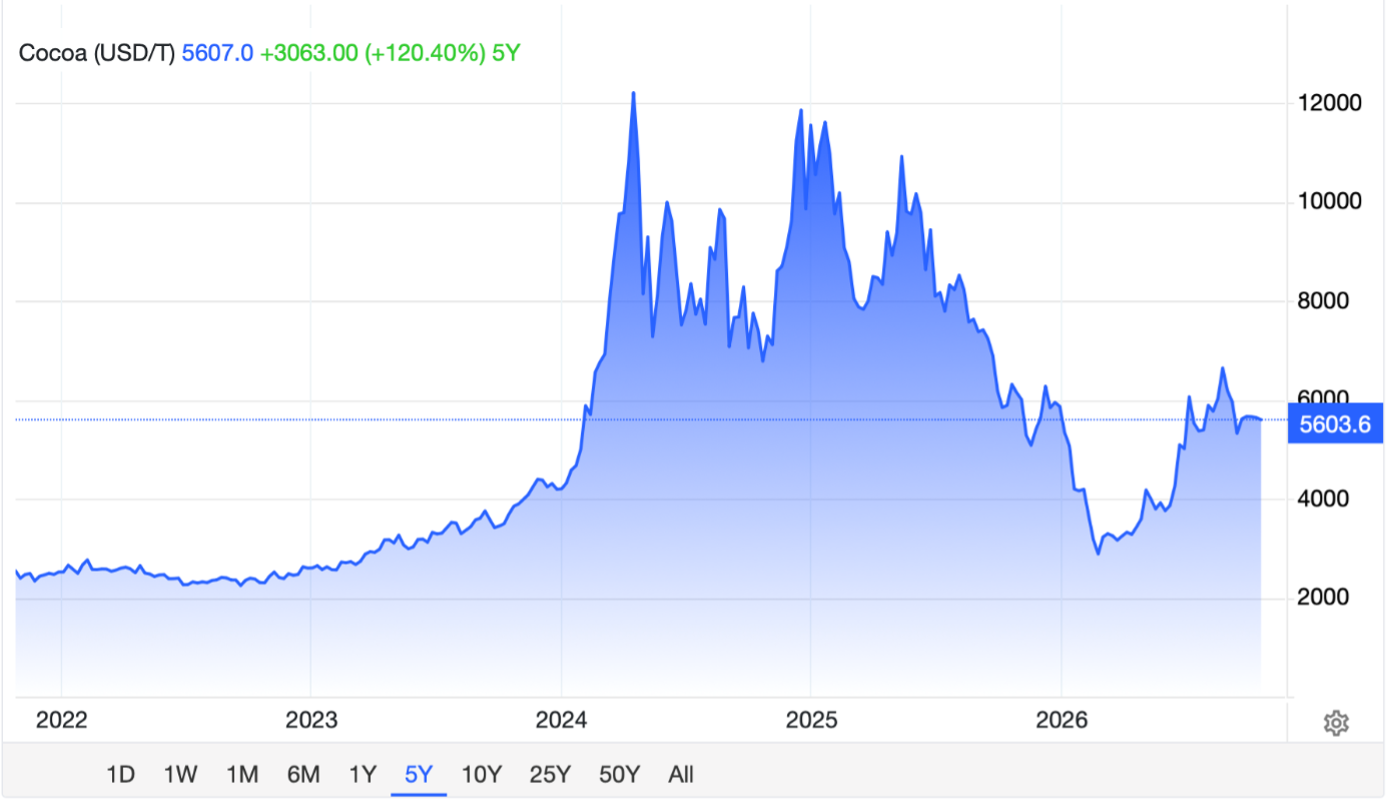
Chart: Development of the price of a chocolate futures contract over the past 10 years. (Source: TradingView)*
The Bean-to-Bar Revolution Versus Cultivated Cocoa
Increasing emphasis is being placed on cocoa origin, quality ingredients and the processing of finished chocolate confectionery. When choosing chocolate, consumers are increasingly asking themselves questions such as: Where does the cocoa come from? Who produced it? How was it made? The chocolate market is constantly changing, and brands that can offer not only high product quality but also authenticity, an interesting story, premium packaging and an experience are gaining prominence. Cultivated chocolate, by contrast, follows the approach of growing cells in a controlled environment. This technology could help diversify sources of cocoa ingredients and ease pressure on traditional supply chains, which face climate change, price fluctuations and risks associated with cultivation, while the future could bring the parallel development of both approaches. However, the role that cultivated cocoa will ultimately play in the market will depend primarily on production costs, the ability to scale up production, the resulting taste and quality, and the ability to gain consumer trust.
You can read more about how much major market players have invested in laboratory-grown chocolate and the projected growth of the chocolate industry in my previous analysis on this topic, entitled Chocolate of the Future? Major Players Invest Billions in “Test-Tube” Cocoa.
*Past performance is not a guarantee of future results.
