









Prominent Brands Involved
Among the most well-known, we can mention Hershey, the manufacturer of the legendary Reese’s, which invested USD 20 million into a biotech company producing lab-grown cocoa. Lindt invested 5.6 million, Mondelēz International—the company behind treats like Oreo and Toblerone—allocated 4.6 million from its budget, and the Kinder brand, which falls under the Ferrero Group, contributed 15 million. The highest investments came from KitKat at 44 million, M&M’s with up to 1.4 billion, and the confectionery manufacturer Mars, which invested a staggering USD 2 billion.
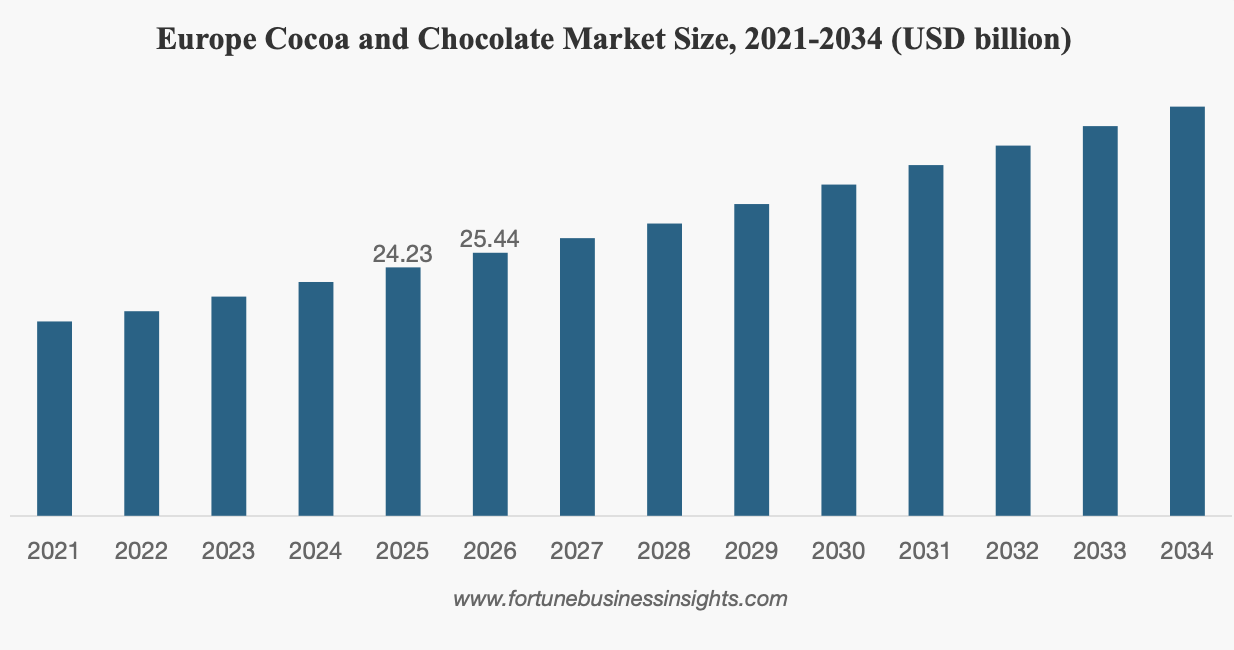
Projected growth of the European cocoa and chocolate market from 2021 to 2034. *[1]
Original or "Fake"?
Following lab-grown meat, which resonated globally a while ago, information about similarly grown cocoa is now coming to the forefront. This naturally raises many questions and concerns, which, according to available information, are unfounded. Cocoa created in laboratory conditions actually originates from cells taken directly from a cacao bean; thus, it is cocoa grown from real fruit cells. It simply does not originate through traditional agriculture, but through cultivation in a controlled laboratory environment. Scientists are also experimenting with manufacturing chocolate from cacao husks, which are typically discarded during conventional chocolate production.
Available as Early as 2027
Israeli startups such as Kokoom and Celleste Bio, along with a number of other companies worldwide, are currently working on lab-grown cocoa. This includes California Cultured, which is still waiting for approval from the Food and Drug Administration (FDA) to launch its chocolate on the market. Despite various rumors circulating that companies are already adding this chocolate to their products, it is not yet commercially available, and products made from this cocoa are tentatively expected to hit store shelves in 2027.
The Ecological Aspect
Cacao trees are often cultivated on deforested land, which degrades soil quality and requires heavy doses of fertilizers and pesticides, meaning lab-grown chocolate could also benefit the environment. However, Sophia Carodenuto, a political geographer specializing in global food systems at the University of Victoria, pointed out the downside of laboratory commodity production in an article for The Guardian: namely, the negative impact on smallholder farmers in West Africa who depend on cacao cultivation and sales for their livelihood. On the other hand, Shirley Temeng-Asomaning, founder and CEO of Chocolate Mall in Ghana, hopes that science will complement farmers rather than compete with them. Given the continuous growth in demand, this latter scenario seems more likely...
Current Market Price Trends
Cocoa prices on the stock exchange reached historic highs in 2024, peaking at USD 12,000 per metric ton. For comparison, at the beginning of June 2026, cocoa futures are trading at around USD 4,000 per ton. Attention is currently focused on the El Niño phenomenon, which could damage harvests in Ghana and the Ivory Coast, countries that account for more than 60 percent of global production. At the same time, prospects for a price recovery in the 2025/2026 season and data on ICE cocoa inventories—which rose to a near two-year high (2,846,957 bags) by May 29—are limiting further price growth for the commodity. *
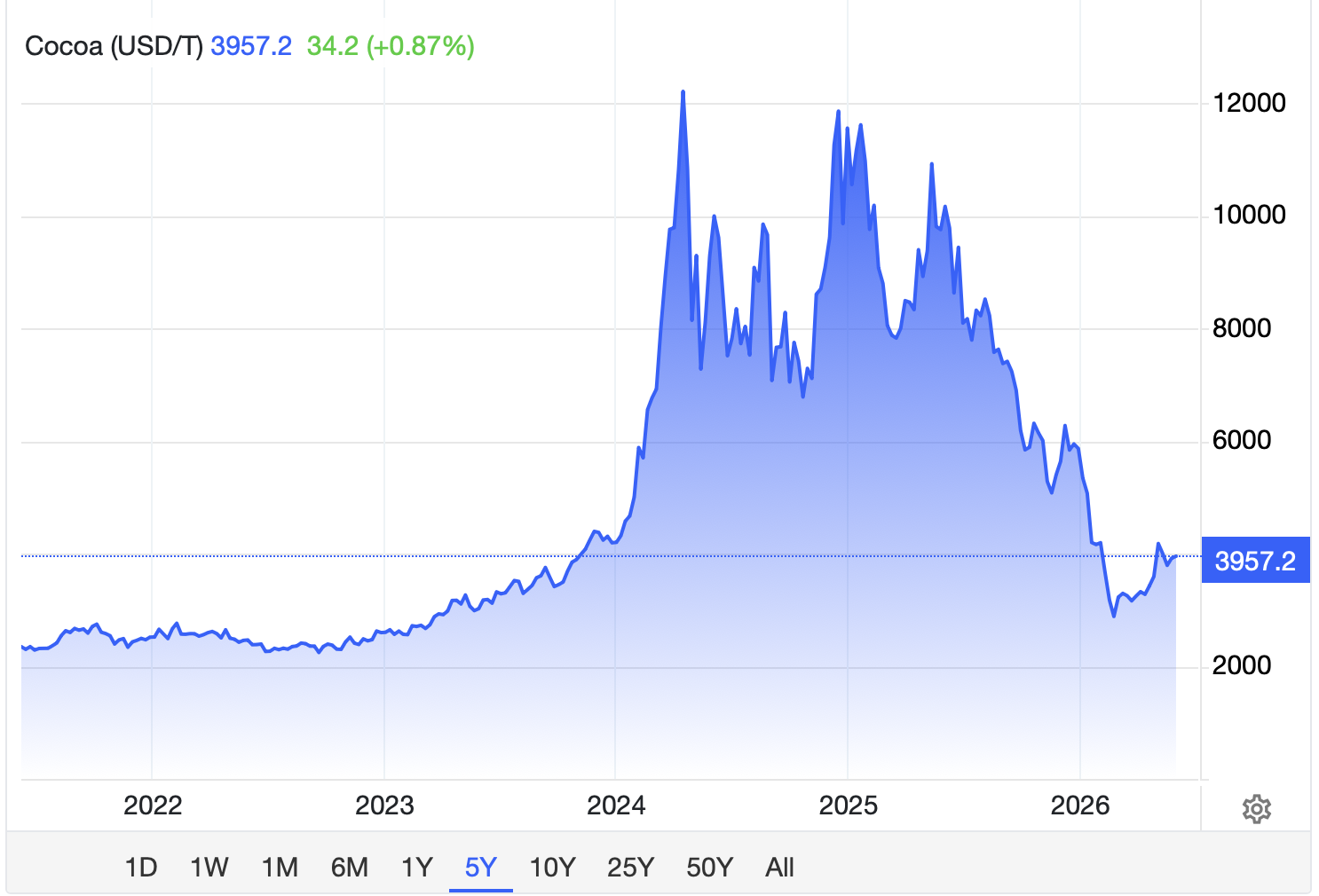
Trend of the cocoa futures contract value over the last 5 years. (Source: TradingEconomics) *
* Past performance is not a guarantee of future results.
[1] Forward-looking statements are based on assumptions and current expectations that may prove inaccurate, or on the current economic environment, which may change. Such statements are not guarantees of future performance. They involve risks and other uncertainties that are difficult to predict. Actual results may differ materially from those expressed or implied in any forward-looking statements.
Photo:Pixabay
