









From Record High to Plunge
The price of orange juice has experienced a significant drop in the first two months of the new year, falling by approximately 37 percent. Futures contracts for frozen concentrated orange juice (FCOJ-A) for May 2025 delivery on the Intercontinental Exchange in New York (ICE) were trading at $301 per 15,000 pounds on February 28, 2025. For better perspective, this equates to about $0.0201 per pound (0.45 kg). By comparison, on September 6, 2024, when the price hit a historic high, it stood at $555. This current correction marks a departure from the trend of the past five years, during which orange juice prices were in an upward trajectory, rising by a total of 150 percent, with the most significant growth occurring last year. However, this correction may just be a natural phenomenon. Looking at the chart, a similar scenario was observed in May 2024 and November 2021, when the commodity's price dropped after reaching new highs.*
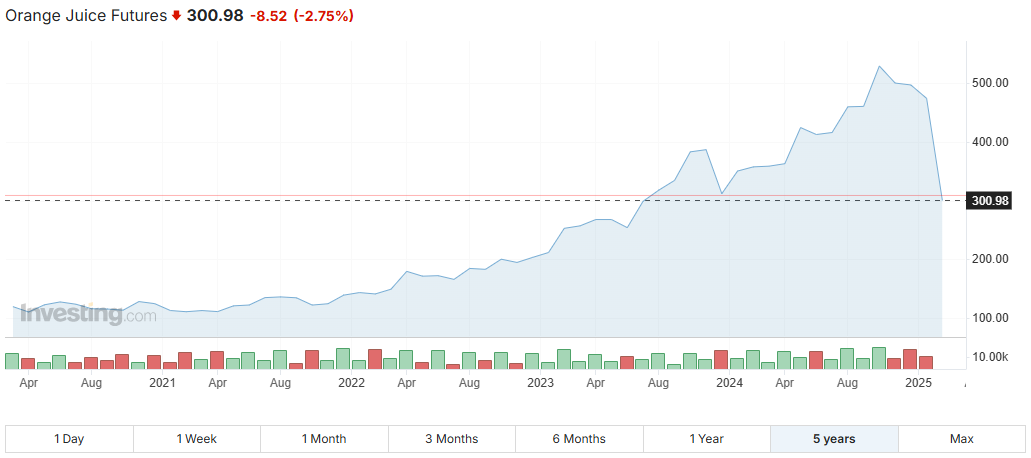
Price development of futures contracts for frozen concentrated orange juice with May 2025 delivery over the past five years. (Source: Investing.com)*
Weather Has Stabilized
Several factors influence the price of orange juice, one of the key ones being improved weather conditions in critical regions. The largest supplier to the U.S. market, Florida, is currently experiencing a period free of hurricanes, which previously devastated vast amounts of crops. Last year's season was among the most destructive, worsened by Tropical Cyclone Milton, which struck the region in early October. According to The Guardian, the Florida Citrus Mutual group, representing 2,000 growers, reported that the cyclone destroyed up to 70 percent of the most productive farms. Weather conditions have also improved in Brazil, the world’s largest orange supplier. After a period of drought, the São Paulo and Triângulo Mineiro regions received rainfall, fostering the growth of new orange blossoms. Experts have described the rainfall as satisfactory. However, prolonged droughts have already damaged the harvest, leading to a **nearly 20 percent decline in Brazilian orange exports in the first half of the 2024/2025 season, according to data from Citrus BR. On the other hand, high prices on the exchange have compensated for farmers' losses, as revenue has increased by 42 percent.
Changes in Consumer Behavior
In addition to supply challenges, consumer demand for orange juice has been decreasing, with beverages like coffee, tea, and water gaining popularity. This shift in preferences is mainly due to the price increases in stores. For instance, in the U.S., the price of orange juice has consistently risen since 1993. According to the U.S. Bureau of Labor Statistics, the price more than doubled over the past nine years, reaching $4.3 per unit. Similarly, data from the Statistical Office of the Slovak Republic (ŠÚ SR) shows that prices of mineral waters and fruit juices on the Slovak market increased by approximately 5 percent in December 2024 compared to 2023. According to a commodity study by the Ministry of Agriculture and Rural Development of the Slovak Republic, the price of oranges in Slovakia reached €1.98 per kilogram in 2023, marking a 15 percent increase from the previous year. While prices have risen, the ŠÚ SR also reports a decline in citrus consumption: in 2023, per capita consumption dropped to 12.7 kg, down from 16.1 kg in the previous year. According to Valor International, this global shift in consumer behavior is also attributed to lower birth rates and an aging population, which prefers alternative beverages.
Forecasts Are Not Optimistic
Despite improved conditions, both farmers and investors remain cautious, as the orange juice market is highly dynamic, and changing climate conditions lead to unpredictable weather shifts, significantly impacting crop yields. For example, in Florida, the hurricane season will resume in June. If it resembles the previous one, crop recovery will be even more challenging. Current estimates indicate that Florida’s production will drop by 36 percent compared to the previous season, reaching just 11.5 million boxes. The situation in Brazil is equally concerning. According to Fundecitrus, the Brazilian harvest in the current season is expected to decline by over 27 percent, totaling 223 million boxes (40.8 kg each) — a 30-year low. Worsening the scenario further, Brazil has started importing oranges from Argentina and Uruguay, as reported by The Rio Times. Another issue worrying farmers is the persistent citrus greening disease. The bacteria responsible for this disease prevent trees from absorbing essential nutrients, leading to fruit not maturing properly and, eventually, the trees dying.
Good for the Economy, Bad for Consumers
Higher orange prices may also be influenced by the trade war between the U.S. and Canada. At the beginning of February 2025, the U.S. imposed higher tariffs on imports from neighboring countries, prompting retaliatory measures. Canada has indefinitely raised tariffs to 25 percent, impacting oranges and orange juice as well. In 2023, a similar tariff increase led to a 5 percent rise in consumer prices in the U.S.. However, this could benefit domestic farmers, as it reduces competition from foreign oranges, ultimately increasing their income. According to EssFeed, in 2022, U.S. growers saw a 15 percent revenue increase, thanks to restrictions on Mexican orange imports.
* Past performance is no guarantee of future results.
