









Millions of Robots Among Us
As reported by Investing.com, forecasts indicate that by the turn of the decade, production could reach 1 million HR units annually, with a market capitalization of up to $20 billion. According to Bernstein, humanoid robots could even surpass the demand for the automotive sector within the next 20 to 30 years. Citi Group expects the number of humanoid robots to rise to 648 million by 2050, while Bank of America (BofA) has issued a much bolder estimate of 3 billion HR units by 2060. Regarding their use, all three banks agree that humanoid robots will be heavily integrated into nursing homes and healthcare, while also highlighting other areas with significant potential. Besides households, where BofA expects the majority of robots to be utilized, other key sectors include retail, delivery services, warehousing, and industry.
The Price Could Drop
There are many areas where such robots could improve operational efficiency, but the main obstacle to wider adoption at present is cost. Since these are advanced machines designed not only to resemble humans in appearance but also to mimic human behavior and integrate with us, their price depends on the complexity of their capabilities and construction. According to Qviro.com, prices can range from $5,000 to $500,000. For example, Tesla’s Optimus robots are expected to cost around $20,000 to $30,000. However, Bank of America (BofA) has compared humanoid robots to electric vehicles, noting that as component prices gradually decreased, adoption expanded—especially in Asia. BofA expects that by 2030, production costs for humanoid robots will fall below $20,000.
China and the U.S. as Leaders
When looking at the geographical distribution of leading companies in humanoid robot development, China and the U.S. are the clear frontrunners. According to Forbes, as of January 25, 2025, the highest number of such companies was in China (8), followed by the U.S. (6), while Canada and the United Kingdom each had one. Reports from BofA and Bernstein further confirm China’s dominant position. The reason is that China approaches humanoid robotics similarly to electric vehicles—quickly and experimentally using a "trial and error" approach. Meanwhile, America's goal is to develop a single, highly efficient "holy grail" of humanoid robots.
The American Dream?
When looking at specific companies, Tesla must be mentioned. The company is not only focused on cars but also on artificial intelligence and robotics. A few years ago, it introduced its first robot, which had significant functional limitations, but the latest improved version, Optimus, can now hold a conversation or pour a drink. However, during its unveiling in October 2024, one of these machines admitted that it was not yet fully autonomous and was still being remotely controlled by a human.
Despite this, Tesla CEO Elon Musk remains optimistic about their progress. During Tesla’s 2025 earnings conference call in January 2025, he stated that the company plans to produce several thousand Optimus units this year. He also expects long-term revenues exceeding $10 trillion.
Despite Musk’s positive predictions, Tesla's stock on the Nasdaq has been struggling due to his current political involvement. Since the beginning of the year, Tesla shares have lost more than 36 percent, reaching $240.68 on March 13, 2025. However, in the long run, they remain in the green—up 42 percent year-over-year and up 360 percent over the past five years.*
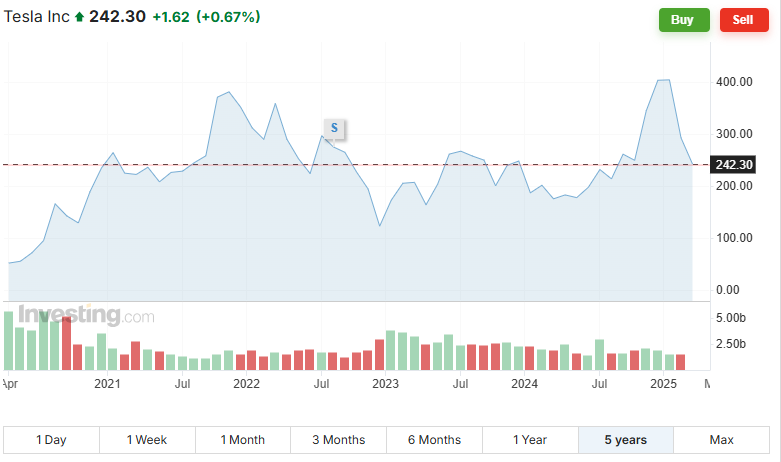
Tesla’s Stock Performance Over the Last 5 Years (Source: Investing.com)*
Billion-Dollar Investments in China
China's leadership in humanoid robot development is further demonstrated by XPeng, a company that has leveraged its experience in electric vehicle manufacturing to expand into robotics. Its latest creation, named Iron, is equipped with AI chips used in vehicles and, according to the company, is three times more efficient than the industry standard. XPeng sees humanoid robots as a clear path to success and is planning to invest nearly $14 billion into their development. The company expects to integrate Level 3 robots into medium-scale commercial production by 2026. In practice, this means that the robots will be autonomous but still require human oversight.
XPeng’s NYSE-listed shares have been performing well, showing strong gains both in the short and long term. On March 13, 2025, XPeng’s stock closed at $25.35, marking a 119 percent increase since the beginning of the year. The stock hit its 52-week high of $26.34 on March 11, 2025. Year-over-year, XPeng shares have risen by 154 percent, though over a five-year period, the growth is a more modest 11 percent.*
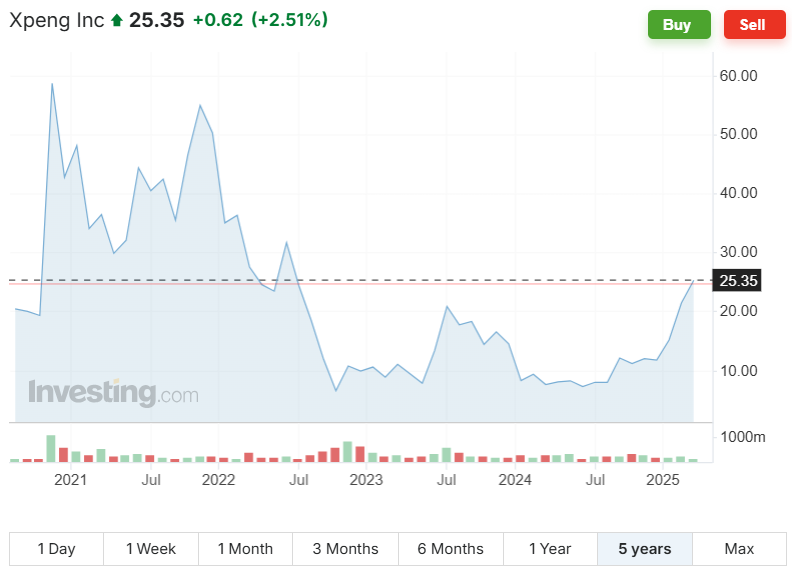
XPeng’s Stock Performance Over the Last 5 Years (Source: Investing.com)*
Offering a Sophisticated AI Model
When it comes to the development of advanced robots, tech giant Nvidia cannot be overlooked. Although the company does not have its own robot, it has introduced the AI model Cosmos, which can be used not only for training humanoid robots but also for industrial robots and autonomous vehicles. Cosmos has been trained for tens of millions of hours on real-life scenarios, which enhances the learning capabilities and skills of robots.
Nvidia’s stock performance on the Nasdaq has been similar to Tesla’s. Since the beginning of the year, Nvidia has lost more than 16 percent, and on March 13, 2025, its stock closed at $115. However, from a long-term perspective, the company remains in good financial shape. Year-over-year, its stock price has increased by 27 percent, and over the last five years, an incredible 1 819 percent.*
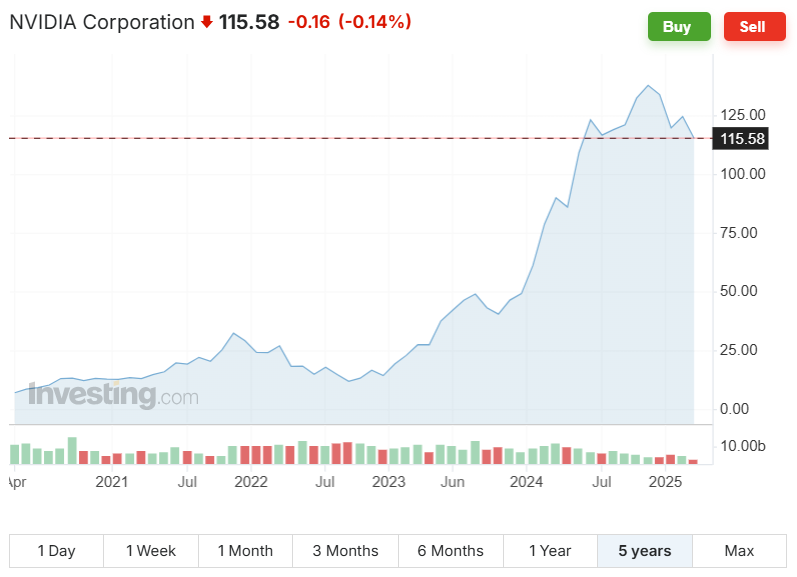
Nvidia’s Stock Performance Over the Last 5 Years (Source: Investing.com)*
Mass Deployment Faces Challenges
Although AI and robotics are advancing rapidly, sophisticated humanoid robots are still in their infancy. There are several types of robots available on the market, but most are prototypes in the early stages of production. This suggests that their capabilities are not yet sufficient to be commercially viable for sale, and further improvements will take years. According to Citi Group, it could take at least two years before significant advancements are made.
Even though manufacturing costs are expected to decline, this remains a new technological sector that still faces issues with an insufficient supply chain and maintenance infrastructure. These factors could extend production timelines and delay deliveries. While these challenges will eventually be resolved, the real question is when we will see robots that truly imitate humans and whether the predictions of investment banks will come true.
*Past performance is not a guarantee of future results.
