









Strong Finish to Fiscal Year 2025
For the fourth quarter of fiscal year 2025, Microsoft reported revenue of $76.44 billion, clearly surpassing the expectations of LSEG analysts, who had projected $73.81 billion. It was also a solid year-over-year growth of 18%. In terms of revenue, net income followed a similar trajectory, growing by more than $5 billion to a total of $27.23 billion. As a result, the financial metric EPS (earnings per share) reached $3.65, which also beat expectations. These strong fundamentals led to an appropriate market response—Microsoft’s stock price surpassed the $550 threshold for the first time, placing it in second position behind Nvidia, with whom it shares a joint push in the field of artificial intelligence.*
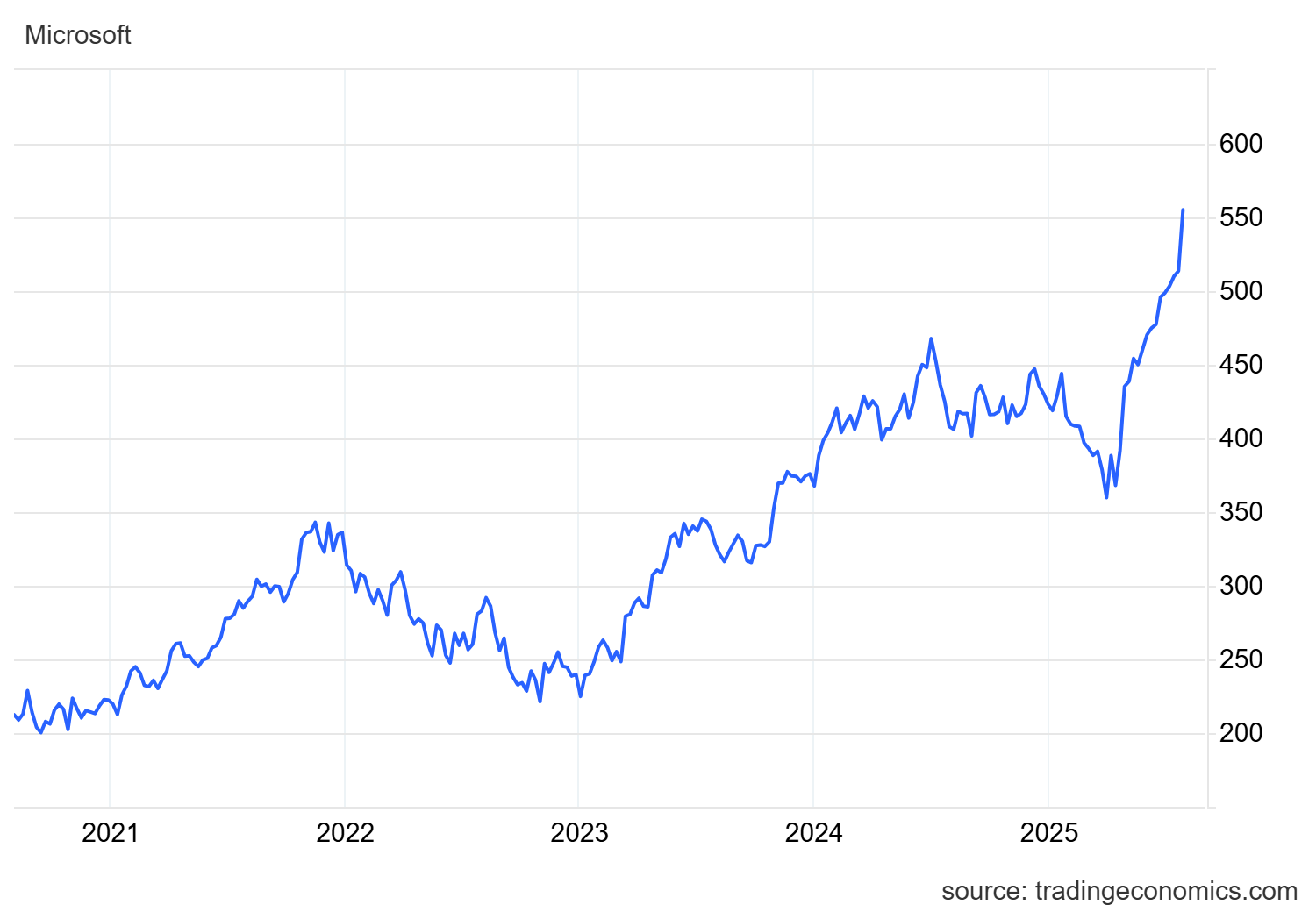
The performance of Microsoft's stock price over the past five years. Source: tradingeconomics.com
The Future Belongs to the Cloud
The company’s success is driven primarily by the outstanding performance of the Intelligent Cloud division, which includes the well-known corporate cloud platform Azure. The division generated $29.88 billion in revenue, representing a 26% increase over the previous year. Azure alone grew by 39%, comfortably beating the expectations of analysts surveyed by StreetAccount and CNBC, who anticipated growth in the range of 34.4% to 35.3%. [1] Additionally, for the first time in its history, Microsoft published its annual revenue from Azure and related cloud services in dollar terms—over $75 billion, marking a 34% increase from the previous year.
The Main Growth Driver
AI-based products—especially Copilot integrated with Office, GitHub, and Windows—are actively used each month by 100 million users. This demonstrates the strength of these tools and shows that Microsoft is building a sustainable business model. These AI tools not only simplify users’ workflows but also increase the company’s average revenue per user within Microsoft365. Lastly, it is important to highlight the growth of the entire Productivity & Business Processes division, which includes these projects. It reported revenue of $33.11 billion, again exceeding market expectations.
How is Windows Doing?
Despite the dominance of cloud and AI, Microsoft hasn’t forgotten about its classic business. The More Personal Computing division—which manages projects like Windows, Xbox, and other devices—reached an impressive $13.45 billion in revenue, reflecting a 9% year-over-year increase. Part of this growth can be attributed to a broader recovery in the desktop PC market. Global PC shipments increased by 4.4% in the last quarter, which clearly contributed to the 3% growth in Windows license sales.
What’s Next for Microsoft?
Looking ahead to the first quarter of fiscal year 2026, expectations remain ambitious. Microsoft projects revenue between $74.7 billion and $75.8 billion, Azure platform growth (at constant currency) of 37%, and an operating margin of 46.6%. In my view, this provides a solid basis for considering stock purchases. However, generally speaking, entering the market at peak price performance is riskier than buying during a price correction. Therefore, a planned purchase amount could be split into two parts, with the second half deployed during a potential correction. [2]
* Past performance is not a guarantee of future results.
[1,2] Forward-looking statements are based on assumptions and current expectations, which may be inaccurate, or on the current economic environment, which is subject to change. Such statements are not a guarantee of future performance. They involve risks and other uncertainties that are difficult to predict. Results could differ materially from those expressed or implied in any forward-looking statements.
