




Gas supplies have decreased after the winter and supplies are threatened by sanctions. Will the price increase?

Although the heating season is slowly coming to an end, gas stocks in storage tanks are running low. This raises the question of replenishment for Europe. However, Russia has decided to refuse payment for supplies in euros and US dollars. From now on, it intends to accept only rubles, which could complicate the situation considerably.  

Russian President Vladimir Putin said last week in a video conference on local state television that he would not accept non-domestic currencies for commodity supplies. He also ordered the state-owned gas company Gazprom to adjust its contracts in this way. The local central bank and the government have been given a one-week transition period to determine how to switch from payments in foreign currencies to payments in rubles. The changes are expected to affect only the currency used to settle payments and countries Russia considers hostile and which impose severe sanctions on it. In total, 48 countries are involved. 


Although supply disruptions are not yet the topic of the day, this step remains one of the options in the tightening of sanctions against Russia. If this were to happen, industry would be the most affected, where production could be curtailed, and households would also be affected later. Central European countries, including Slovakia, would be particularly affected by the 'shortage', not to mention the fact that prices would go up significantly. This would also affect electricity prices. The prices of both commodities have been rising for some time as a result of the energy crisis. [1]


Russia accounts for around 40 percent of Europe's gas supply. According to the European Commission's European Gas Market Report, total gas consumption in Europe for the full year 2020 reached 394 billion cubic meters of gas. The United States has agreed to increase its gas supplies to Europe and, according to a White House statement, has committed to supply 50 billion cubic metres of gas from next year, roughly the same as the Nord Stream 1 pipeline from Russia to Germany today.  


The European Commission's statement shows that it plans to reduce the EU's dependence on Russian gas by two-thirds and to end its dependence on Russian supplies of the commodity much earlier than 2030. This is to be achieved by a faster transition to clean energy and alternative sources, with individual countries being responsible for implementing these steps.


However, the information available so far suggests that, as things stand, Europe would face an energy deficit even if the US, Norway and Azerbaijan were to send as much of the commodity as possible. 


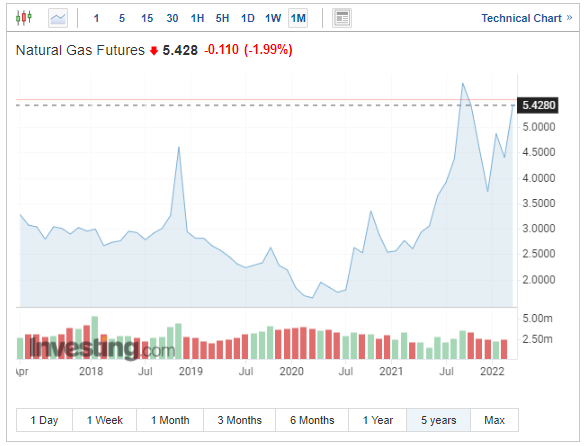
The price of the gas futures contract has risen 45% since the beginning of 2022 to more than $5.4 per MMBtu. That's a year-over-year increase of as much as 106%. The commodity's five-year performance has seen a slightly lower appreciation at 72%. *
 

WI grafffffffff

Graph: Development of the value of the natural gas futures contract over a five-year horizon. (Source: Investing.com)


Of course, the rise in the price of the commodity itself is positively reflected in the rise in the value of shares of companies such as natural gas or oil producers. If concerns about gas shortages persist or the situation escalates, prices can be expected to rise further. Conversely, if the situation manages to stabilise, a slight correction from current levels is likely [2].


* Past performance is no guarantee of future results


[1,2] Forward-looking statements are based on assumptions and current expectations, which may be inaccurate, or on the current economic environment, which may change. These statements are not guarantees of future performance. They involve risks and other uncertainties that are difficult to predict. Results may differ materially from those expressed or implied by any forward-looking statements.

This text constitutes marketing communication. It is not any form of investment advice or investment research or an offer for any transactions in financial instrument. Its content does not take into consideration individual circumstances of the readers, their experience or financial situation. The past performance is not a guarantee or prediction of future results.

🍪 Slapukai

Mes naudojame slapukus, kad galėtume saugoti, naudoti ir tvarkyti asmens duomenis, siekdami užtikrinti Jums geriausią interneto patirtį. Spausdami „Sutinku su slapukais“ Jūs sutinkate, kad būtų saugomi visi slapukai, ir užtikrinate geriausi Galite keisti slapukų nustatymus arba atšaukti sutikimą spustelėdami „Slapukų nustatymai“. Norėdami sužinoti daugiau apie slapukus ir jų tikslus, perskaitykite mūsų Slapukų politiką ir Privatumo pranešimą.

Cookies settings


Slapukų kontrolė

Kas yra slapukai?

Slapukai yra nedideli tekstiniai failai, kurie leidžia mums ir mūsų paslaugų teikėjams unikaliai identifikuoti jūsų naršyklę ar įrenginį. Slapukai paprastai veikia priskirdami jūsų įrenginiui unikalų numerį ir yra saugomi jūsų naršyklėje jūsų lankomų svetainių bei tų svetainių trečiųjų šalių paslaugų teikėjų. Terminas „slapukai“ apima ir kitas technologijas, pvz., SDK, pikselius ir vietinę saugyklą.


Jei įjungta

Mes galime atpažinti jus kaip klientą, o tai leidžia teikti individualizuotas paslaugas, turinį ir reklamą, užtikrinti paslaugų veiksmingumą ir atpažinti įrenginį, kad būtų užtikrintas didesnis saugumas. Mes galime pagerinti jūsų patirtį remdamiesi jūsų ankstesne sesija. Mes galime stebėti jūsų pageidavimus ir individualizuoti paslaugas.
Mes galime pagerinti svetainės veikimą.


Jei išjungta

Mes negalėsime prisiminti jūsų ankstesnių sesijų, todėl negalėsime pritaikyti svetainės pagal jūsų pageidavimus.
Be slapukų kai kurios funkcijos gali būti neprieinamos, o vartotojo patirtis gali pablogėti.


„Būtinai reikalingi“ reiškia, kad be jų negalima užtikrinti pagrindinių svetainės funkcijų. Kadangi šie slapukai yra būtini tinkamam svetainės funkcijų ir paslaugų veikimui bei saugumui užtikrinti, jūs negalite atsisakyti naudoti šias technologijas. Jūs vis tiek galite juos užblokuoti savo naršyklėje, tačiau tai gali sutrikdyti pagrindinių svetainės funkcijų veikimą.

  • Privatumo nustatymų konfigūravimas
  • Saugus prisijungimas
  • Saugus ryšys naudojantis paslaugomis
  • Formų pildymas

Analizės ir veiklos stebėjimo technologijos, skirtos analizuoti, kaip naudojatės Svetainę.

  • Dažniausiai peržiūrimos puslapiai
  • Sąveika su turiniu
  • Klaidų analizė
  • Įvairių projektų efektyvumo testavimas ir matavimas

Svetainė gali naudoti trečiųjų šalių reklamos ir rinkodaros technologijas.

  • Reklamuokite mūsų paslaugas kitose platformose ir svetainėse
  • Įvertinkite mūsų kampanijų veiksmingumą

Rizikos įspėjimas: CFD yra sudėtingi instrumentai ir dėl sverto jie kelia didelę riziką greitai prarasti pinigus. 71.96% mažmeninių investuotojų sąskaitų praranda pinigus prekiaudami CFD su šiuo teikėju. Turėtumėte apsvarstyti, ar suprantate, kaip veikia CFD, ir ar galite sau leisti prisiimti didelę riziką prarasti savo pinigus.