









A sharp contrast
In terms of revenue, the company reported a year-on-year increase of 12 percent to 28.10 billion, which is also about 1.7 billion USD more than analysts from the London Stock Exchange Group (LSEG) had expected. The main issue, however, was net profit, which fell by 37 percent to 1.37 billion USD. Based on this, earnings per share (EPS) reached 0.50 USD*, falling short of expectations, which stood at 0.54 USD. There are several reasons for this decline, with the main ones being a sharp increase in operating costs — specifically by 50 percent — primarily in research, development, and projects related to artificial intelligence.
Record deliveries
On the other hand, in terms of deliveries, Tesla maintained a relatively strong pace. For the third quarter, 497,099 delivered vehicles were reported, which also represents a new record. Nevertheless, total deliveries since the beginning of the year reached 1.2 million units, which is 6 percent less than in 2024. This ultimately surprised investors, as the United States saw the end of electric vehicle tax credits initiated by President Donald Trump, and therefore an increase in consumer purchases had been expected instead.
Tesla Energy
While the automotive division is slowing down, the main growth driver during the third quarter was Tesla’s energy division, which accounted for roughly one quarter of total revenue. In monetary terms, it brought in 3.42 billion USD, representing a 44 percent increase compared to the previous year. Corporate solutions such as Megapack and new solar products are becoming increasingly important for large data centers — for example, xAI, Musk’s AI startup, is among the key clients of this division.
Future projects and market reaction
Tesla’s management sees the company’s future trajectory largely tied to experimental projects such as the Robotaxi named Cybercab, which is expected to enter mass production in 2026, with a pilot service already underway in Austin. Production of the electric Semi truck and the launch of the third generation of the humanoid robot Optimus are also in preparation. Although these visions are encouraging, investors are looking for clearer figures — not just promises without a concrete financial outlook, which Musk unfortunately did not provide during the conference call. As a result, following the release of the results, Tesla’s stock price fell by more than 5 percent, bringing this year’s performance down to just 9 percent.*
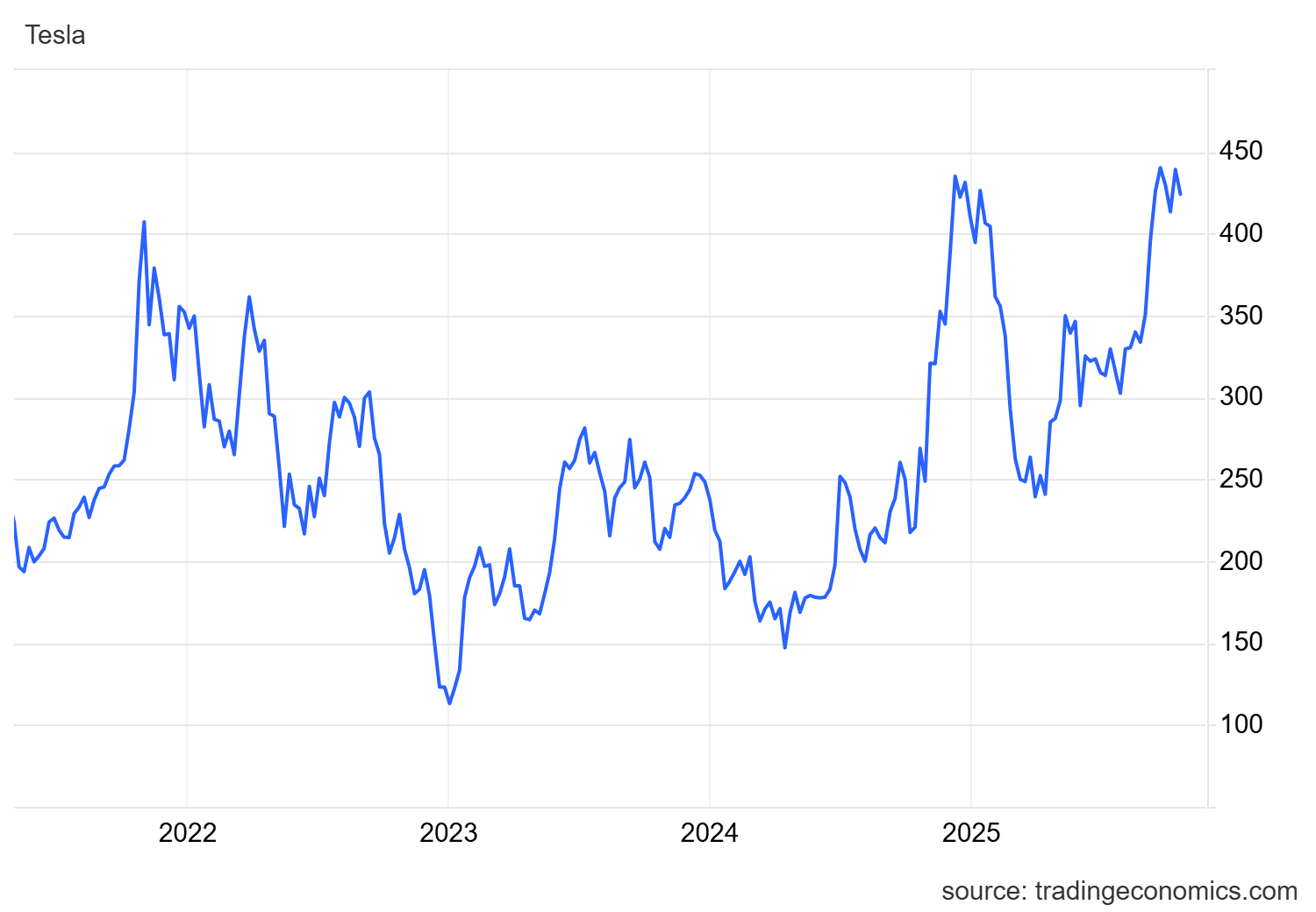
Tesla stock price performance over the past five years*
*Past performance is not a guarantee of future results.
