




Chocolate of the Future? Big Players Are Investing Billions in "Lab-Grown" Cocoa

The price of chocolate has risen rapidly in recent years, turning this sweet treat into what is literally becoming a "luxury good." This is the result of climate change, drought, and related diseases that threaten cacao trees on plantations and cause production shortfalls, as well as a lack of investment. However, it seems that researchers have found an answer to this problem in the form of cocoa grown directly in laboratories.
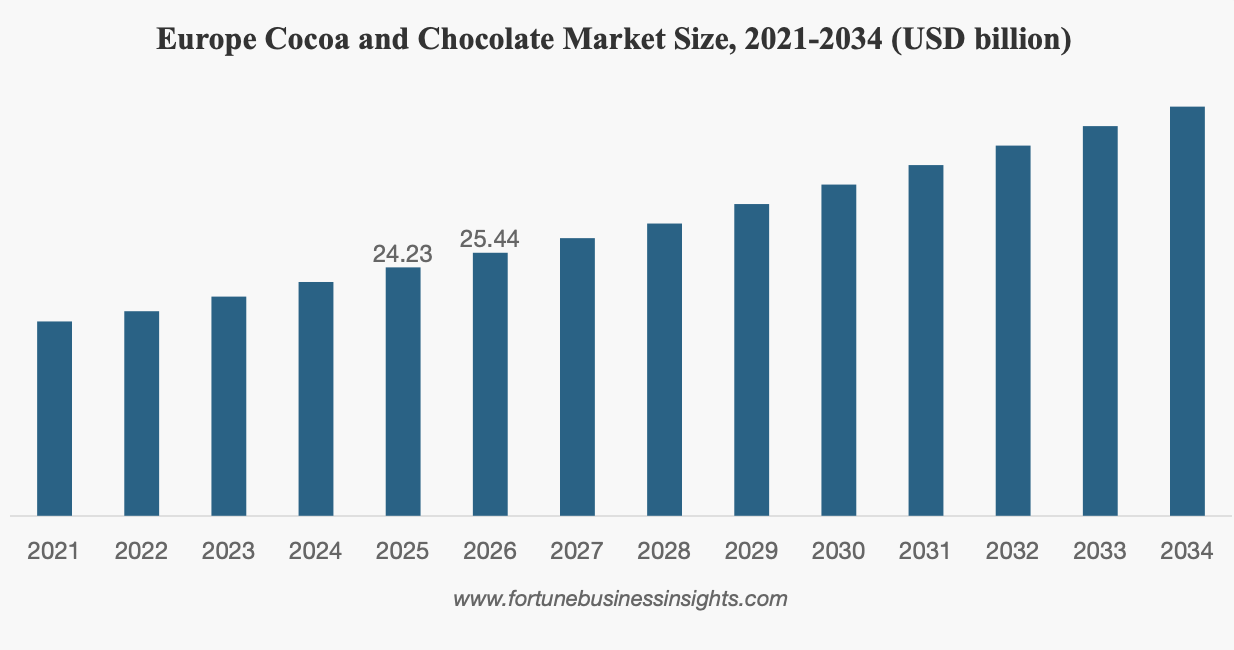
Cocoa is one of the most strategic commodities since it is used in chocolates and a wide range of other confections, but the aforementioned problems complicate its cultivation. According to data from The Guardian, more than 7 million metric tons of cocoa are consumed globally each year. As reported by Fortune Business Insights, the global chocolate and cocoa market was valued at USD 55.87 billion in 2025, with expected growth to USD 86.52 billion by 2034. Major market players are therefore investing enormous financial resources into the research and development of lab-grown cocoa. [1]

Prominent Brands Involved

Among the most well-known, we can mention Hershey, the manufacturer of the legendary Reese’s, which invested USD 20 million into a biotech company producing lab-grown cocoa. Lindt invested 5.6 million, Mondelēz International—the company behind treats like Oreo and Toblerone—allocated 4.6 million from its budget, and the Kinder brand, which falls under the Ferrero Group, contributed 15 million. The highest investments came from KitKat at 44 million, M&M’s with up to 1.4 billion, and the confectionery manufacturer Mars, which invested a staggering USD 2 billion.
Snímka obrazovky 2026-06-04 o 16.46.36

Projected growth of the European cocoa and chocolate market from 2021 to 2034. *[1]

Original or "Fake"?

Following lab-grown meat, which resonated globally a while ago, information about similarly grown cocoa is now coming to the forefront. This naturally raises many questions and concerns, which, according to available information, are unfounded. Cocoa created in laboratory conditions actually originates from cells taken directly from a cacao bean; thus, it is cocoa grown from real fruit cells. It simply does not originate through traditional agriculture, but through cultivation in a controlled laboratory environment. Scientists are also experimenting with manufacturing chocolate from cacao husks, which are typically discarded during conventional chocolate production.

Available as Early as 2027

Israeli startups such as Kokoom and Celleste Bio, along with a number of other companies worldwide, are currently working on lab-grown cocoa. This includes California Cultured, which is still waiting for approval from the Food and Drug Administration (FDA) to launch its chocolate on the market. Despite various rumors circulating that companies are already adding this chocolate to their products, it is not yet commercially available, and products made from this cocoa are tentatively expected to hit store shelves in 2027.

The Ecological Aspect

Cacao trees are often cultivated on deforested land, which degrades soil quality and requires heavy doses of fertilizers and pesticides, meaning lab-grown chocolate could also benefit the environment. However, Sophia Carodenuto, a political geographer specializing in global food systems at the University of Victoria, pointed out the downside of laboratory commodity production in an article for The Guardian: namely, the negative impact on smallholder farmers in West Africa who depend on cacao cultivation and sales for their livelihood. On the other hand, Shirley Temeng-Asomaning, founder and CEO of Chocolate Mall in Ghana, hopes that science will complement farmers rather than compete with them. Given the continuous growth in demand, this latter scenario seems more likely...

Current Market Price Trends

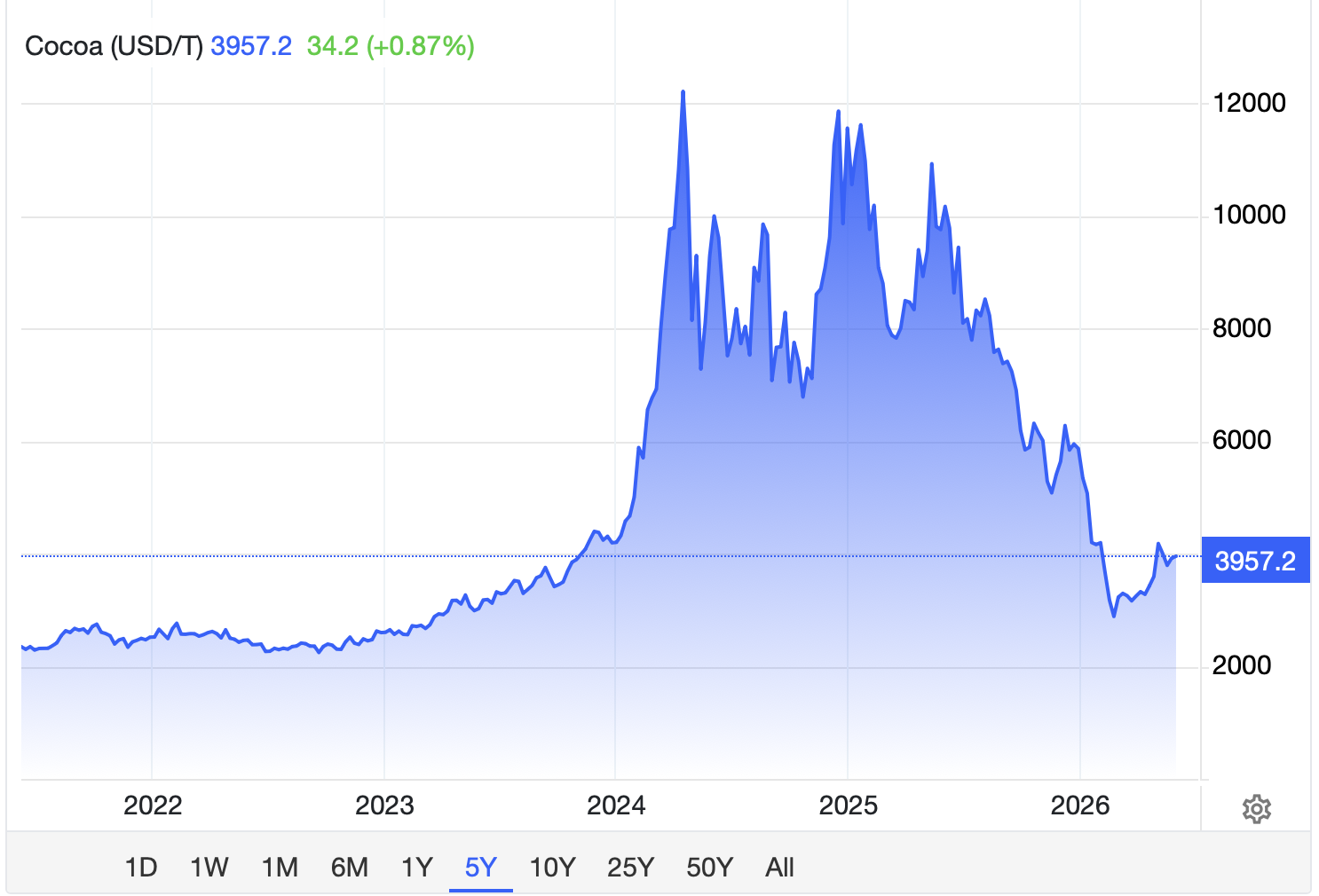
Cocoa prices on the stock exchange reached historic highs in 2024, peaking at USD 12,000 per metric ton. For comparison, at the beginning of June 2026, cocoa futures are trading at around USD 4,000 per ton. Attention is currently focused on the El Niño phenomenon, which could damage harvests in Ghana and the Ivory Coast, countries that account for more than 60 percent of global production. At the same time, prospects for a price recovery in the 2025/2026 season and data on ICE cocoa inventories—which rose to a near two-year high (2,846,957 bags) by May 29—are limiting further price growth for the commodity. *
Snímka obrazovky 2026-06-04 o 14.31.39

Trend of the cocoa futures contract value over the last 5 years. (Source: TradingEconomics) *

* Past performance is not a guarantee of future results.

[1] Forward-looking statements are based on assumptions and current expectations that may prove inaccurate, or on the current economic environment, which may change. Such statements are not guarantees of future performance. They involve risks and other uncertainties that are difficult to predict. Actual results may differ materially from those expressed or implied in any forward-looking statements.

Photo:Pixabay

This text constitutes marketing communication. It is not any form of investment advice or investment research or an offer for any transactions in financial instrument. Its content does not take into consideration individual circumstances of the readers, their experience or financial situation. The past performance is not a guarantee or prediction of future results.

🍪 Cookies

We use cookies to store, access and process personal data to give you the best online experience. By clicking Accept Cookies you consent to storing all cookies and ensure best website performance. You can modify cookie preferences or withdraw consent by clicking Cookie Settings. To find out more about cookies and purposes, read our Cookie Policy and Privacy Notice.

Cookies settings


Cookie Control

What are cookies?

Cookies are small text files that enable us, and our service provides to uniquely identify your browser or device. Cookies normally work by assigning a unique number to your device and are stored on your browser by the websites that you visit as well as third-party service providers for those website. By the term cookies other technologies as SDKs, pixels and local storage are to be considered.


If Enabled

We may recognize you as a customer which enables customized services, content and advertising, services effectiveness and device recognition for enhanced security
We may improve your experience based on your previous session
We can keep track of your preferences and personalize services
We can improve the performance of Website.


If Disabled

We won't be able to remember your previous sessions, that won't allow us to tailor the website according to your preferences
Some features might not be available and user experience reduced without cookies


Strictly necessary means that essential functions of the Website can not be provided without using them. Because these cookies are essential for the properly working and secure of Website features and services, you cannot opt-out of using these technologies. You can still block them within your browser, but it might cause the disfunction of basic website features.

  • Setting privacy preferences
  • Secure log in
  • Secure connection during the usage of services
  • Filling forms

Analytics and performance tracking technologies to analyze how you use the Website.

  • Most viewed pages
  • Interaction with content
  • Error analysis
  • Testing and Measuring various design effectivity

The Website may use third-party advertising and marketing technologies.

  • Promote our services on other platforms and websites
  • Measure the effectiveness of our campaigns

Risk warning: CFDs are complex instruments and come with a high risk of losing money rapidly due to leverage. 78.70% of retail investor accounts lose money when trading CFDs with this provider. You should consider whether you understand how CFDs work and whether you can afford to take the high risk of losing your money.